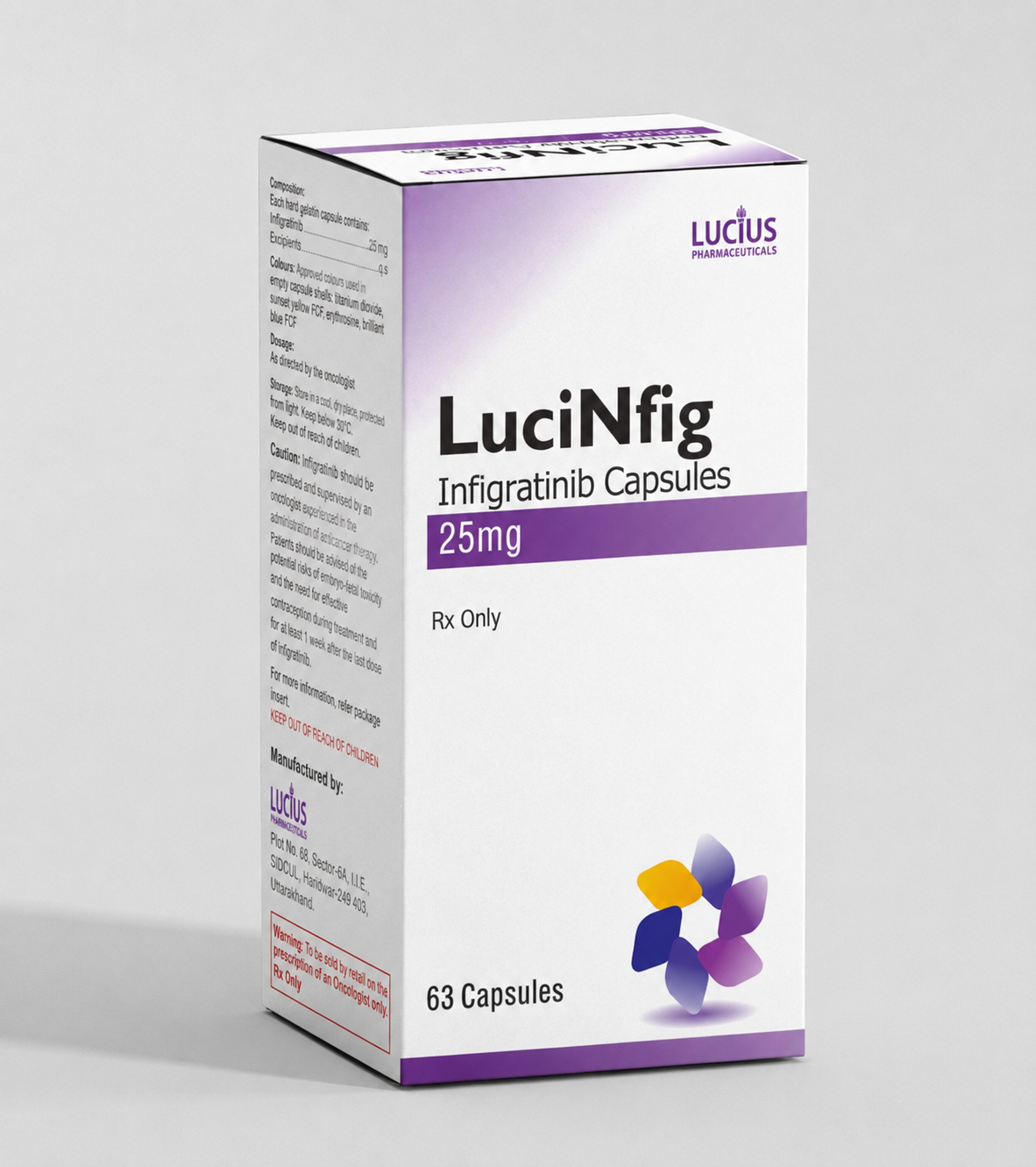
LuciNfig 25mg, (Infigratinib) Capsules:
LuciNfig 25 Mg is a pharmaceutical formulation containing Infigratinib, a targeted therapy used in the treatment of specific cancers, notably cholangiocarcinoma (bile duct cancer) and Urothelial Carcinoma. As a selective fibroblast growth factor receptor (FGFR) inhibitor, it represents a significant advancement in precision oncology, where therapies are tailored to the molecular profile of the cancer rather than its location alone
What is LuciNfig 25mg (Infigratinib)?
LuciNfig 25mg is an oral cancer therapy primarily prescribed for adults with locally advanced or metastatic cholangiocarcinoma that harbors FGFR2 gene fusions or rearrangements. It is also being investigated and used in other cancers like urothelial carcinoma (bladder cancer) with FGFR alterations. Developed as a small-molecule inhibitor, Infigratinib disrupts critical growth signals in cancer cells driven by FGFR genetic mutations, slowing or halting tumor progression.
How It Works:
Infigratinib works by inhibiting the activity of FGFR1, FGFR2, and FGFR3, which are proteins involved in cell growth, survival, migration, and differentiation. In normal cells, FGFR signaling is tightly regulated, but in some cancers, mutations or gene fusions in FGFRs cause continuous activation, leading to uncontrolled cell division and tumor growth.
Infigratinib binds to the ATP-binding pocket of FGFR1-3 and blocks downstream signaling pathways such as:
- MAPK pathway
- PI3K-AKT pathway
- STAT pathway
By inhibiting these pathways, the drug reduces proliferation and induces apoptosis (cell death) in tumor cells dependent on FGFR alterations.
How to Use:
LuciNfig is specifically indicated for:
- Cholangiocarcinoma (bile duct cancer): For patients with FGFR2 gene fusions or rearrangements.
- usually applied following improvement on at least one previous systemic treatment.
- Urothelial carcinoma (under clinical evaluation): for tumors with FGFR3 mutations.
- Use of this medication requires companion diagnostic testing to confirm the presence of eligible FGFR genetic abnormalities.
Dosage:
Recommended dosage:
125 mg once day on an empty stomach (often five 25 mg LuciNfig pills) for 21 days in a row, followed by 7 days off therapy (28-day cycle).
Administration tips:
- Take on an empty stomach (at least 1 hour before or 2 hours after a meal).
- Swallow tablets whole with water.
- Avoid cutting, crushing, or chewing the tablet.
Missed dose:
- If missed by less than 4 hours, take it as soon as remembered.
- If more than 4 hours late or nearing the next dose, skip it—do not double dose.
Other Dosage Information
Dosage modifications may be required based on:
- Adverse reactions
- Liver or kidney function
Drug interactions
Dose reductions:
May be necessary in cases of elevated phosphate levels, eye disorders, or other grade 3–4 toxicities. The drug may be paused, reduced (to 100 mg, 75 mg, or 50 mg), or discontinued based on severity.
- Pediatric use: Not established.
- Geriatric use: Use with caution; monitor closely.
Side Effects:
Like all anticancer medications, LuciNfig may cause side effects. Common and serious side effects include:
- Hyperphosphatemia (elevated phosphate levels)
- Stomatitis (mouth sores)
- Dry mouth
- Nail changes
- Hair loss (alopecia)
- Fatigue
- Constipation
- Decreased appetite
- Dysgeusia (altered taste)
- Dry eyes or eye pain
Serious side effects:
- Retinal detachment or central serous retinopathy
- Increased phosphate levels leading to tissue calcification
- Hepatotoxicity (liver damage)
- Electrolyte imbalance
- Severe gastrointestinal issues
- Patients should be monitored regularly with eye exams, phosphate levels, liver function tests, and clinical evaluations for early detection of complications.
Storage:
- Store at room temperature (20°C to 25°C).
- Keep away from moisture, direct sunlight, and children.
- Do not use beyond the expiration date.
Conclusion:
LuciNfig 25mg (Infigratinib) stands at the frontier of personalized cancer therapy, offering hope to patients with FGFR-driven malignancies like cholangiocarcinoma. Its targeted mechanism, coupled with oral dosing, makes it a preferable option over conventional chemotherapy for eligible patients. However, its usage requires careful monitoring due to potential side effects and interactions. Through precise FGFR testing, appropriate patient selection, and close supervision, LuciNfig can significantly impact outcomes in hard-to-treat cancers.

Reviews
There are no reviews yet.