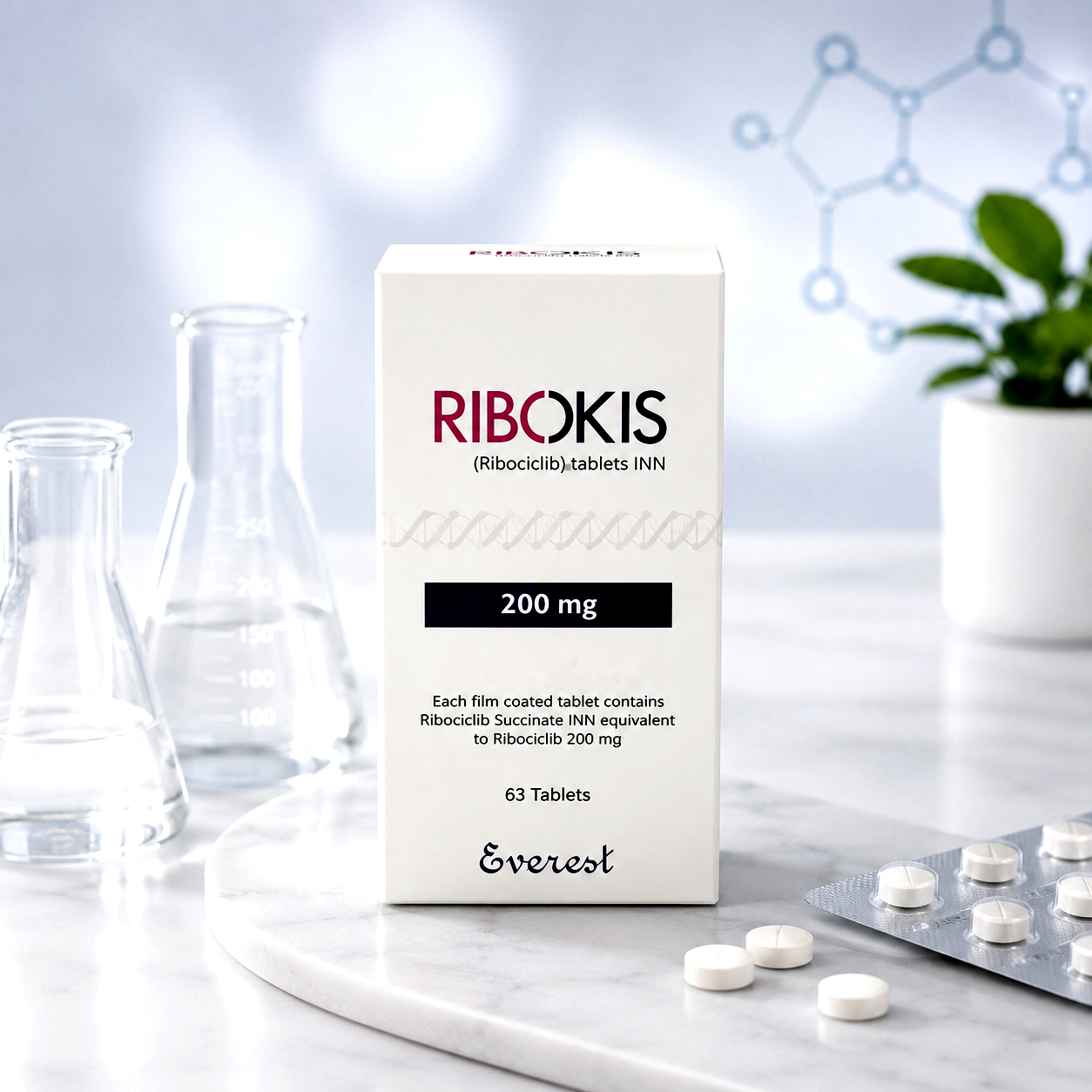
Ribociclib belongs to a class of medicines known as cyclin-dependent kinase (CDK) 4/6 inhibitors. It works by blocking the activity of CDK4 and CDK6 proteins, which are involved in promoting the growth and division of cancer cells. By inhibiting these proteins, Ribokis helps slow or stop the proliferation of cancer cells, thereby delaying disease progression.
Key Benefits:
- Indicated for HR-positive, HER2-negative advanced or metastatic breast cancer
- A selective CDK4/6 inhibitor
- Helps slow the growth and spread of cancer cells
- Commonly used in combination with endocrine (hormonal) therapy
- Prescription-only medication
Important: Ribokis should be taken only under the supervision of a qualified healthcare professional. The dosage and treatment schedule should be determined by the treating physician based on the patient’s clinical condition.
Ribokis 200 Mg is ananti-cancer medicine classified as a picky cyclin-dependent kinase( CDK) 4 and 6 asset, retailed in Bangladesh under the brand name Ribokis( general of Kisqali brand). In addition, intended to reduce the growth of hormone receptor – positive( HR) and HER2 ‑ negative advanced or metastatic bone cancer by inhibiting critical proteins that propel the proliferation of cancer cells.
Action:
Ribokis 200 Mg functions by inhibiting CDK4 and CDK6 enzymes. CDK4 and CDK6 enzymes, after activation with cyclin. In addition, d, phosphorylate the retinoblastoma protein( pRb), causing G1 to S phase progression of the cell cycle. Inhibiting CDK4/ 6, ribociclib results in cancer cell inhibition in the G1 phase, inhibiting proliferation.
Preclinical studies show ribociclib reduces pRb phosphorylation in bone cancer cell lines, performing in tumour retrogression utmost successfully used in combination with hormone curatives similar as letrozole or fulvestrant.
suggestion:
Ribociclib is approved for adult cases with HR, HER2 ‑ negative advanced or metastatic bone cancer, in combination with
Aromatase impediments( eg, letrozole) as original endocrine remedy
Fulvestrant, either as first- line treatment or in case of progression
Pre- or perimenopausal women, with luteinizing- hormone – releasing hormone analogues
Recent blessings( Sept 2024 USA, Nov 2024 EU) have also made it available for high- threat early- stage bone cancer( Stage II/ III) in the adjuvant setting.
Dosing:
Usual authority 600 mg( three 200 mg tablets) once a day, with or without food, for 21 days, followed by a medicine-free interval of 7 days; the cycles are repeated every 28 days
Cure adaptation Cure reduction to 400 mg or 200 mg may be necessary for cure- limiting venom( e.g., Grade 3 neutropenia); in case of patient toxin on 200 mg, termination is advised.
Missed cure If puking occurs or if a cure is missed, do n’t take an redundant cure on that day — capsule coming listed cure.
Special populations gestation and lactation are contraindicated( fetal detriment verified in beast studies).
Use effective contraception during treatment and for at least 3 weeks after.
Acclimate boluses for severe/ moderate liver or order impairment.
Monitoring:
birth & ongoing ECG and electrolytes( K ⁺, Mg ² ⁺, Ca ² ⁺, phosphorus) on launch and on Day 14 of Cycle 1, also Cycle
CBC Q 2 weeks for cycles 1 and 2, also yearly or as clinically indicated
Liver function tests( AST/ ALT) Q 2 weeks during Cycle 2, also q 4 weeks.
Clinical monitoring: In addition, examiner for substantiation of infection, cardiac complications, respiratory torture, severe skin response or liver abnormalities.
Pharmacies:
Pharmacokinetics
- Time to Peak Concentration (Tmax): 1–4 hours after administration
- Steady-State Achievement: Approximately 8 days
- Protein Binding: ~70% plasma protein-bound
- Metabolism: Primarily metabolized by CYP3A4
- Elimination Half-Life: Approximately 32 hours
- Excretion: 69% via feces and 23% via urine
Common & Serious Side Effects:
The following adverse reactions have been reported during treatment.
Hematologic:
- Neutropenia (77%)
- Leukopenia
- Anemia
- Thrombocytopenia
- Lymphopenia
Hepatic:
- Increased AST and ALT levels
- Hepatobiliary toxicity (24%)
Gastrointestinal:
- Nausea (53%)
- Diarrhea (38%)
- Vomiting (33%)
- Constipation (28%)
Other Common Adverse Effects:
- Fatigue (41%)
- Alopecia (34%)
- Rash (22%)
- Headache
- Cough
- Back pain
- Infections
- Elevated serum creatinine
- Increased blood glucose levels

Reviews
There are no reviews yet.